Table of Contents
- Why Platform Choice Can Shape Business Growth
- Understanding the Core Difference Between WordPress and Shopify
- Ease of Setup and Daily Management
- Flexibility and Creative Control
- Selling Online: eCommerce Strengths Compared
- SEO and Search Visibility
- Cost Considerations Beyond the Starting Price
- Scalability and Long-Term Business Strategy
- Security, Maintenance, and Ownership
- Which Platform Fits Different Business Models?
- Final Thoughts
Why Platform Choice Can Shape Business Growth
Choosing a website platform is not simply a technical decision—it often affects how your business markets itself, attracts customers, and expands over time.
A platform should support your current needs, but it should also align with where your business may go next.
Some businesses need a straightforward online store they can launch quickly. Others need broader flexibility, content authority, lead generation tools, and deeper control over branding.
The platform you choose can influence:
- Search visibility
- Website functionality
- Customer experience
- Marketing options
- Long-term operating costs
For that reason, comparing WordPress and Shopify is less about finding a universal winner and more about identifying which platform better supports your business strategy.
Understanding the Core Difference Between WordPress and Shopify
Although both platforms can support online businesses, they were built with different priorities.
WordPress
WordPress began as a content-focused platform and evolved into a highly adaptable website ecosystem.
With the right tools, it can support:
- Business websites
- Blogs
- Service-based brands
- Membership platforms
- Portfolio sites
- eCommerce stores through WooCommerce
Its strength lies in flexibility.
Shopify
Shopify was designed primarily for online selling.
Its ecosystem focuses heavily on:
- Product listings
- Inventory
- Payment systems
- Order management
- Shipping workflows
Its strength lies in streamlined commerce.
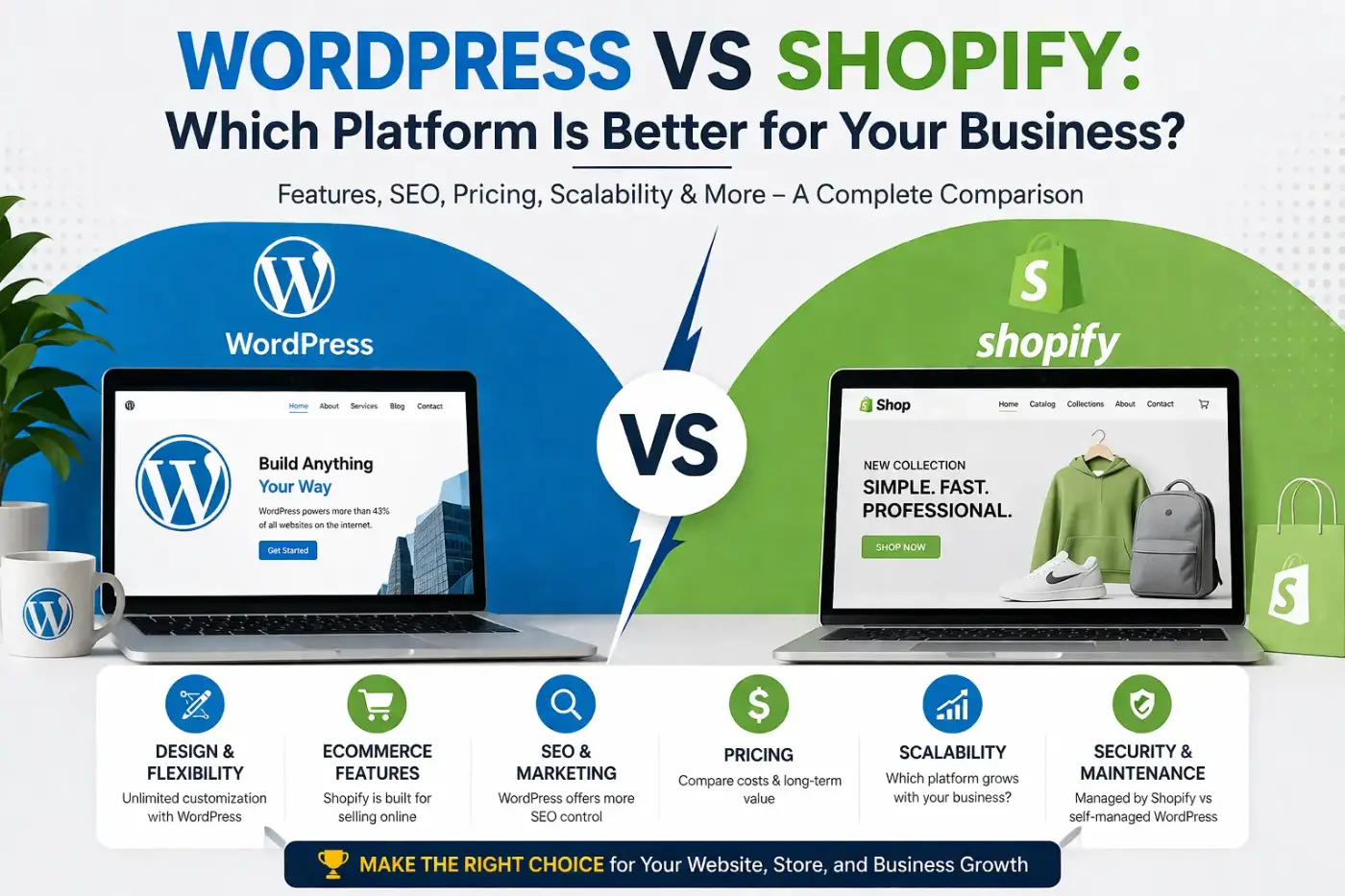
In simple terms, WordPress often offers broader digital flexibility, while Shopify often prioritizes simplified store management.
Ease of Setup and Daily Management
For many business owners, usability matters.
Shopify: Simplicity First
Shopify is often appealing because it removes much of the technical complexity involved in launching an online store.
Users can typically manage:
- Products
- Payments
- Orders
- Shipping
without extensive setup.
This can be useful for businesses that want speed and convenience.
WordPress: More Freedom, More Responsibility
WordPress often requires more involvement, especially when managing hosting, plugins, and optimization.
That additional responsibility may feel demanding at first, but it also allows greater customization and ownership.
For some businesses, convenience matters most. For others, control matters more.
Flexibility and Creative Control
Website needs can vary dramatically from one business to another.
WordPress Advantages
WordPress often stands out for businesses that want more than just an online store.
It can support:
- Advanced landing pages
- Custom brand experiences
- SEO-focused blogs
- Lead generation funnels
- Online courses
- Service-based websites
Because of its broad ecosystem, businesses often have more freedom to shape the website around their strategy.
Shopify Advantages
Shopify offers polished store-focused templates, but broader customization may feel more structured.
For businesses with straightforward product-selling goals, this may be perfectly sufficient.
For brands seeking broader website diversity, WordPress may offer more room.
Selling Online: eCommerce Strengths Compared
Both platforms can sell products, but they approach commerce differently.
Shopify
Shopify emphasizes direct commerce efficiency.
This often includes:
- Built-in checkout systems
- Product inventory
- Shipping workflows
- Payment integrations
It is often built for businesses that want to focus on selling without managing as much backend complexity.
WordPress with WooCommerce
WooCommerce can create highly capable stores while offering more customization.
This may benefit businesses that want:
- Greater design control
- Content-heavy sales funnels
- SEO-driven product pages
- Unique customer journeys
The trade-off is that flexibility may require more setup.
SEO and Search Visibility
Search traffic can become one of the most valuable long-term assets for online growth.
WordPress and SEO
WordPress is often favored by businesses that rely heavily on content marketing and organic visibility.
Its advantages may include:
- Greater content structure flexibility
- Advanced optimization plugins
- Custom URL control
- Blog integration
- Technical SEO adaptability
Shopify and SEO
Shopify supports many core SEO essentials, but some businesses may find it less flexible for advanced optimization.
For brands focused heavily on content-led search growth, WordPress may provide stronger strategic options.
Cost Considerations Beyond the Starting Price
Initial pricing rarely tells the full story.
Shopify
Shopify typically offers predictable subscription pricing, which can simplify budgeting.
However, additional apps, transaction fees, and scaling costs may increase over time.
WordPress
WordPress costs can vary based on:
- Hosting quality
- Themes
- Plugins
- Maintenance
- Development needs
This flexibility can create either cost efficiency or complexity depending on business decisions.
The real question is often not “Which is cheaper?” but “Which cost structure aligns with my growth plan?”
Scalability and Long-Term Business Strategy
Business growth rarely stays static.
Shopify
Shopify often scales well for businesses centered around product commerce.
WordPress
WordPress may offer broader adaptability for businesses that may later expand into:
- SEO publishing
- Lead generation
- Digital services
- Memberships
- Educational platforms
If your business may evolve beyond products alone, flexibility can become valuable.
Security, Maintenance, and Ownership
Shopify
Shopify handles many technical responsibilities directly, which can reduce maintenance concerns.
WordPress
WordPress places more control—and more responsibility—in the hands of the website owner.
This means:
- Greater ownership
- More customization
- More maintenance decisions
For some, managed simplicity is ideal. For others, ownership is worth the extra effort.
Which Platform Fits Different Business Models?
WordPress May Be Better If You:
- Prioritize SEO growth
- Need content marketing
- Want broader website capabilities
- Require design flexibility
- Plan long-term brand expansion
Shopify May Be Better If You:
- Want quick eCommerce setup
- Focus primarily on product sales
- Prefer simplified operations
- Want less technical involvement
The best platform often depends less on features alone and more on business direction.